Tag Archives: BDL

The Iranian Startup Ecosystem

Written by
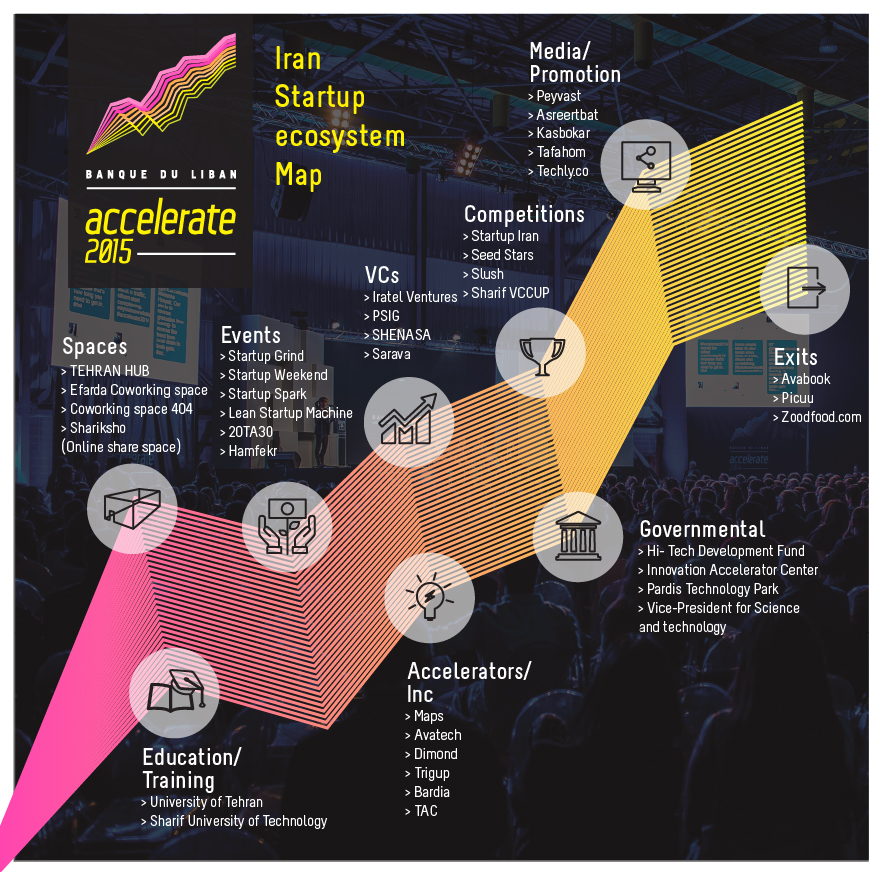
chart-IRAN-

Just days after the nuclear deal agreement in Vienna, European countries and companies filled up planes with their nations’ economic elite to head to Iran to get a move on gaining ground in one of the largest untouched emerging markets. The current population of Iran is around 80M, 53M of which are below the age of 35, and 55M are Internet users. Iran also has the highest number of educated individuals in the MENA region as well as the highest mobile penetration rate in the region at 120%.

During the decade long implementation of sanctions on Iran to cripple the $400 billion economy on multiple levels, Iranian startups have had to operate without access to foreign markets, finances, and social media channels. Many used this to their advantage by creating their localized versions of international startups and building startups according to local needs, including the Amazon-inspired marketplace Digikala — now valued at up to $500 million, the Groupon-like Takhfifan, leading Android app store Café Bazaar, audio and video streaming services Aparat (YouTube) and Navaak (Spotify), Esam (similar to Ebay), social network Cloob, and Hamijoo (Kickstarter).

Businesses were forced to collaborate and interact with other locals, since they were cut off from the rest of the world, empowering the startup ecosystem. The startup scene developed without any international competitors or the influence of massive external businesses; however, due to the sanctions, Iran’s startups were constrained since they were only capable of growing as big as Iran’s population, albeit that is not a small number.

In terms of human talent, considering the high percentage of university graduates and a high youth unemployment rate at 25%, there is a myriad of candidates for any open positions. It also is worth mentioning that there are noticeably more female entrepreneurs in Iran than in other ecosystems, which may be due to the fact that 70% of technology, science, and engineering students in Iran are women. However, although there are several well established and successful startups, none have been able to exit due to the sanctions, and as such, the ecosystem lacks role models and success stories.

The lifting of the sanctions will benefit the Iranian startup ecosystem by providing more opportunities and access to different markets, causing them to thrive and mature, as well as raise competition with both local and global players. Many of the seed stage and early stage companies dominant in their markets can raise foreign investments in order to expand.

Several events have been taking place outside the country to develop relationships and educate investors on the startup scene, as well as to build connections with its diaspora. For instance, in June, the iBridges conference gathered 2000 participants in Berlin, mostly Iranians living in the US, Europe and Iran as well as foreign investors and seasoned Silicon Valley entrepreneurs. The conference highlighted potential investment opportunities in the startup scene once the sanctions are lifted, explored the role that the startup ecosystem could play in Iran’s development, and the millions of jobs that could be created if the country moved towards a knowledge-based economy.

Although the startup ecosystem in Iran is behind other countries in the region, with a low competitive market and many untouched markets and segments, plus very low operation costs and salaries, it will be able to thrive and expand much faster than its regional counterparts. It is not hard to believe that Iran could become the startup hub of the region considering all the interest, especially from investors to invest in it. With a rapidly growing ecosystem and the lifting of the sanctions, more and more international startup professionals are flying to Iran to collaborate and connect with the potentials the country has to offer.

According to a study by Migreat, the majority of entrepreneurial migrants to the US are going from the region. It really is no surprise; the region has a long history of entrepreneurship since it is where international trade started a long time ago, and seems to be an innate trait of the culture. By developing solid ecosystems, entrepreneurs would be encouraged to remain in the region. Under the theme ‘Emerging Startup Ecosystems,” BDL Accelerate 2015 aims to discuss the challenges and best practices of emerging ecosystems, including Iran, to exchange knowledge and explore opportunities the ecosystems can collaborate to create a competitive region and mature their ecosystems.

To register to attend click here.

Startup Registration in Lebanon: SAL vs. SARL

Written by


registration

Lebanon has an open economy with liberal laws designed to encourage commercial activity and foreign investment. Generally, all companies are governed by the Lebanese Commercial Code and its regulations and unlike many countries in the region, the Lebanese law does not require joint ventures to have a specific percentage of Lebanese ownership. There are a few ways to register your company in Lebanon, and below are brief descriptions of the most widely used companies in Lebanon: Joint Stock Companies (Société Anonyme Libanaise or s.a.l.) and Limited Liability Companies (Société à responsabilité limitée or s.a.r.l).

Both types of companies limit the liability of the shareholders to their capital contribution. In other words, in case of losses, the risks of a shareholder are those of losing the capital it contributed without its personal assets being at stake.

Joint Stock Companies (Société Anonyme Libanaise or s.a.l.)
A joint stock company is an association of funds contributed by three or more persons. It should have a minimum authorized capital of LL 30 million, which is equivalent to around $20 k. Shareholders are entitled to membership in the company, a right to participate in management, and a right to vote.

Lebanese law does not limit foreign interest in joint stock companies except for the guarantee shares held by the directors and a few indirect limitations such as that the Board of Directors must have at least three Lebanese members out of the maximum 12 allowed, and that the chairman/general manager should be Lebanese. Also, joint stock companies that acquire and trade in real estate are required to have at least 50 percent of the capital held by Lebanese nationals. Joint stock companies have the option to issue shares and bonds convertible into shares.

Limited Liability Companies (Société à responsabilité limitée or s.a.r.l.)
A limited liability company is one whose liability is limited to the contributions of its 3 to 30 partners/shareholders and allows 100 percent foreign ownership. The exception to that is for commercial representation activities in which the majority of the shareholders and the majority of share capital should be by Lebanese nationals.

SARL should have a capital of LL 5 million, which is equivalent to around $ 3,333. Shares are not freely transferable and require the prior approval of members representing 75 percent of the capital.

Management of the company could be given to one or more partners. The company must be formed with the mutual consent of the members. Legal incapacity of bankruptcy of a member does not require the dissolution of the company. 

As described, SAL and SARL have different minimum capital requirements and shares are more easily transferred in a SAL compared to in a SARL. Another main difference between the two is that SAL is more anonymous in nature that the identity of the shareholders does not play an important role in the company’s business.

BDL Accelerate 2015 Tours Universities

Written by

With Lebanon ranked globally as 10th in overall quality of education, and 4th in science and math (according to a 2013 World Economic Forum report), our nation’s startup potential is tremendous.

In the spirit of finding the next generation of entrepreneurs, the BDL Accelerate 2015 Team will be visiting all major universities in Lebanon over the coming weeks to inspire youths to join the startup movement and attend the Conference. NRJ Radio and Nostalgie will be tagging along to spread the word further and farther. High school students are also encouraged to attend, with a couple of schools already scheduling class trips for their senior students.

If you are a professor / instructor / teacher, and would like to attend with your class, please contact us on +961 70 68 46 73 or by email at students@bdlaccelerate.com.

EyeEm: Background & Achievements since BDL Accelerate 2014

Written by

EyeEmLebanese-born Ramzi Rizk is a prime example of how hard work, dedication and passion can all lead to success. Ramzi moved to Hamburg, Germany to work on his M.Sc. in Software Architecture and later moved to Berlin to work on his Phd on Privacy in Social Media.

One night, while Florian Meissner and Lorenz Aschoff were hanging out at Ramzi’s place, Florian shared an idea he had from a revelation he got when his camera was stolen in New York in 2009 and he had used a friend’s iPhone to take pictures. Florian was impressed by the growing scene of mobile photographers and got the idea of a photo sharing app that does more than your average app.

Together in February 2011, the friends, Ramzi, Florian, Lorenz and Gen Sadakane started building a platform that enables mobile photographers to connect and do more than simply share images – they founded EyeEm. Prior to launching the app, the friends organized a few photographer exhibitions and published a book about it.

Ramzi was one of the speakers at BDL Accelerate 2014 discussing the journey EyeEm took from an idea discussed in a living room, to having over 13 million users in over 130 countries today while constantly adding new features empowering the community. Since Ramzi was with us last year, EyeEm bought Sight.io , an aesthetic algorithm that judges photos based on composition, color saturation and perspective, for an undisclosed amount, and raised $18 million in new venture funding led by Valar Ventures and existing investors Earlybird Ventures, Passion Capital, Wellington Partners, Atlantic Labs, and Open Ocean Capital.

The team behind EyeEm shows no signs of slowing down and is working long and hard hours to enhance users’ experience on the app truly reflecting that success is derived from a lot of hard work and dedication.

Lifecycle of a Startup

Written by

startup process

Discovery
In the first phase as an entrepreneur, identify a meaningful problem and come up with a solution that people would be interested in. During this phase, learn about the lean startup methodology, assess the market, conduct interviews with potential consumers, figure out the most compelling value proposition of the product, and put together a founding team.

Validation & Product development
The startup’s product goes from being a hypothetical solution to minimum viable product created with minimal resources. Have early organic users test it out and get their feedback. Iterate your idea to adapt to the feedback received and test again. Use the learnings and iteration to obtain Product Market Fit (PMF). During this phase, hire key team members, refine your pitching skills, and join an accelerator or start attracting investors.

Efficiency
Once the product is PMF and ready for full-blown product development, refine all core features of the product, fix the leaky product, and start with studying product marketing. Learn the best channels and methods to acquire customers and start obtaining the first paying customers. The aim is to increase the customer base in the most effective way. Focus on activation and retention. Be prepared for the scaling phase.

Scale
It’s time to prove that the startup has the capacity to grow in a sustainable manner while keeping costs down. It is time for the larger fundraising rounds. Consider if you want to grow within the market via new product lines and/or research new markets for strategic expansion. Build a solid infrastructure, grow the team and create the company culture.

Mature
With the support of large fundraising rounds, you managed to scale. Now is not the time to click on cruise control and admire what you have done. Problems may arise at this phase that you can’t afford to put on the back burner. In order to increase the longevity of your business and to sustain profits or grow, tackle the problems instantly. The startup should have significant revenue at this phase; plan how you want to further expand with product lines and/or market expansions. Start planning the exit strategy and future growth of the company.

Exit or renew
The business model is working and credible. The funding is available to expand and you have succeeded. You have two choices at this phase, either to exit by selling the startup or to go public.

The startup life cycle is crucial to how one can acquire the resources for what the brand will require to grow, renew, and constantly reinvent itself in the vigorous market.